


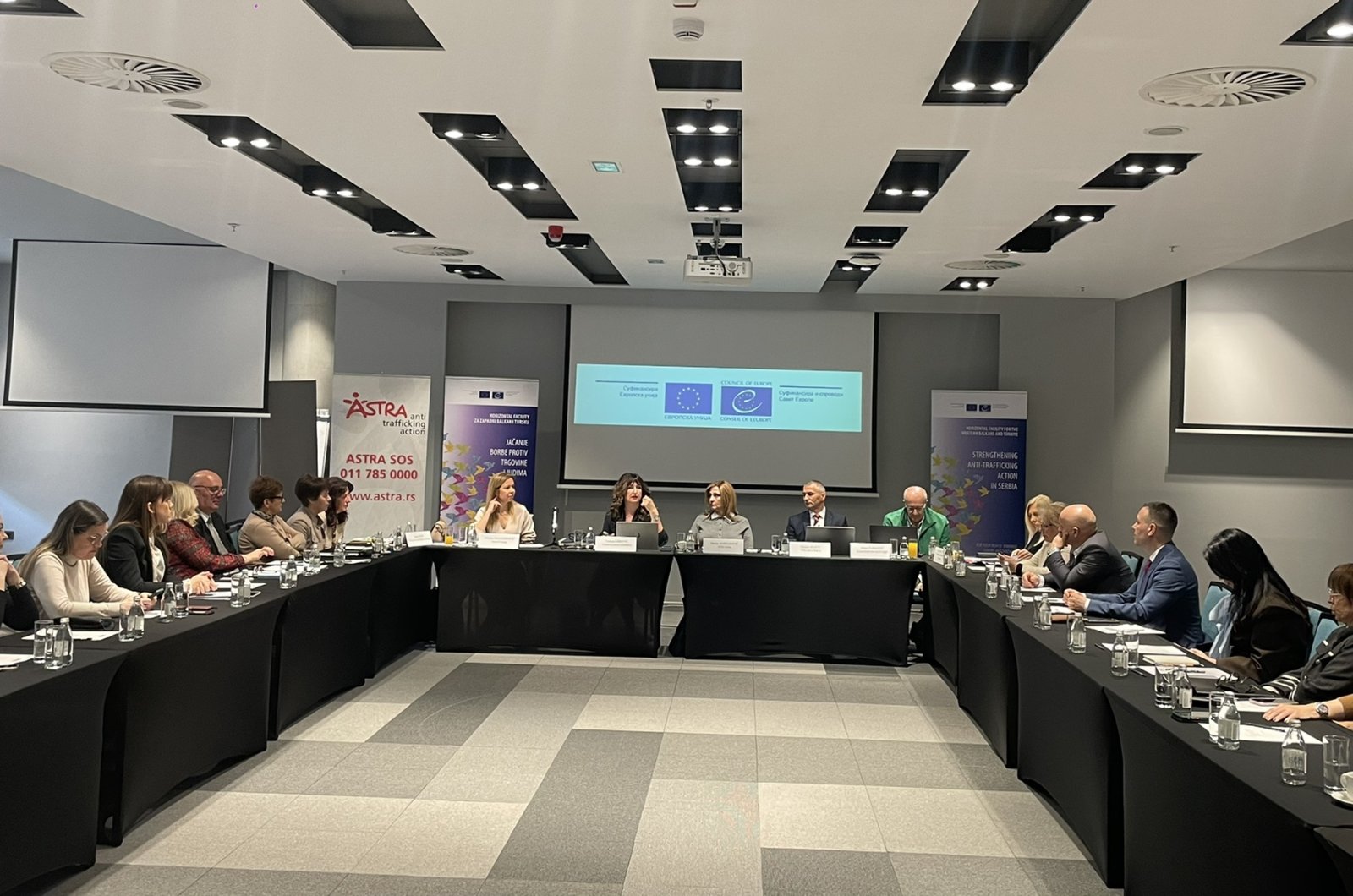
Within the framework of the joint programme of the European Union and the Council of Europe “Horizontal Facility for the Western Balkans and Türkiye”, in cooperation with the Supreme Public Prosecutor’s Office and ASTRA – Anti-Trafficking Action, a roundtable was organised on 2 April 2026, dedicated to improving practice in handling human trafficking cases.
The event was held in Belgrade and brought together representatives of prosecutor’s offices from across Serbia, with the aim of strengthening the role of prosecutors as contact points, enhancing cooperation, and facilitating the exchange of experience in prosecuting this complex form of crime.
In the opening session, Tamara Mirović from the Supreme Public Prosecutor’s Office, Prof. Dr Milan Žarković, and ASTRA’s Director Marija Anđelković addressed the participants, highlighting the importance of a coordinated, efficient, and victim-centred approach in combating human trafficking.
The central part of the event focused on the analysis of judicial practice in cases of human trafficking for the purpose of forced begging and sexual exploitation. Through the presentation of concrete court decisions, including judgments of higher courts, participants discussed key issues related to the legal qualification of offences, proving elements of coercion, abuse of trust and vulnerability, as well as the role of different actors in the chain of perpetration.
A speaker at the event was Mladen Jeličić, a judge of the Higher Court in Šabac, who presented a final judgment under Article 388 (human trafficking) concerning forced begging.
The second part of the programme addressed challenges in cases of human trafficking for the purpose of sexual exploitation, through a case study and exchange of experiences, with a focus on distinguishing this offence from related criminal offences, as well as evidentiary challenges in proceedings.
The final session was dedicated to identifying key challenges in practice and formulating recommendations for improving the qualification of criminal offences, strengthening a victim-centred approach, and enhancing inter-institutional cooperation.
The roundtable represents an important step in strengthening the capacities of prosecutor’s offices and improving Serbia’s response to human trafficking, with the continued support of the Council of Europe and the cooperation of all relevant stakeholders.