


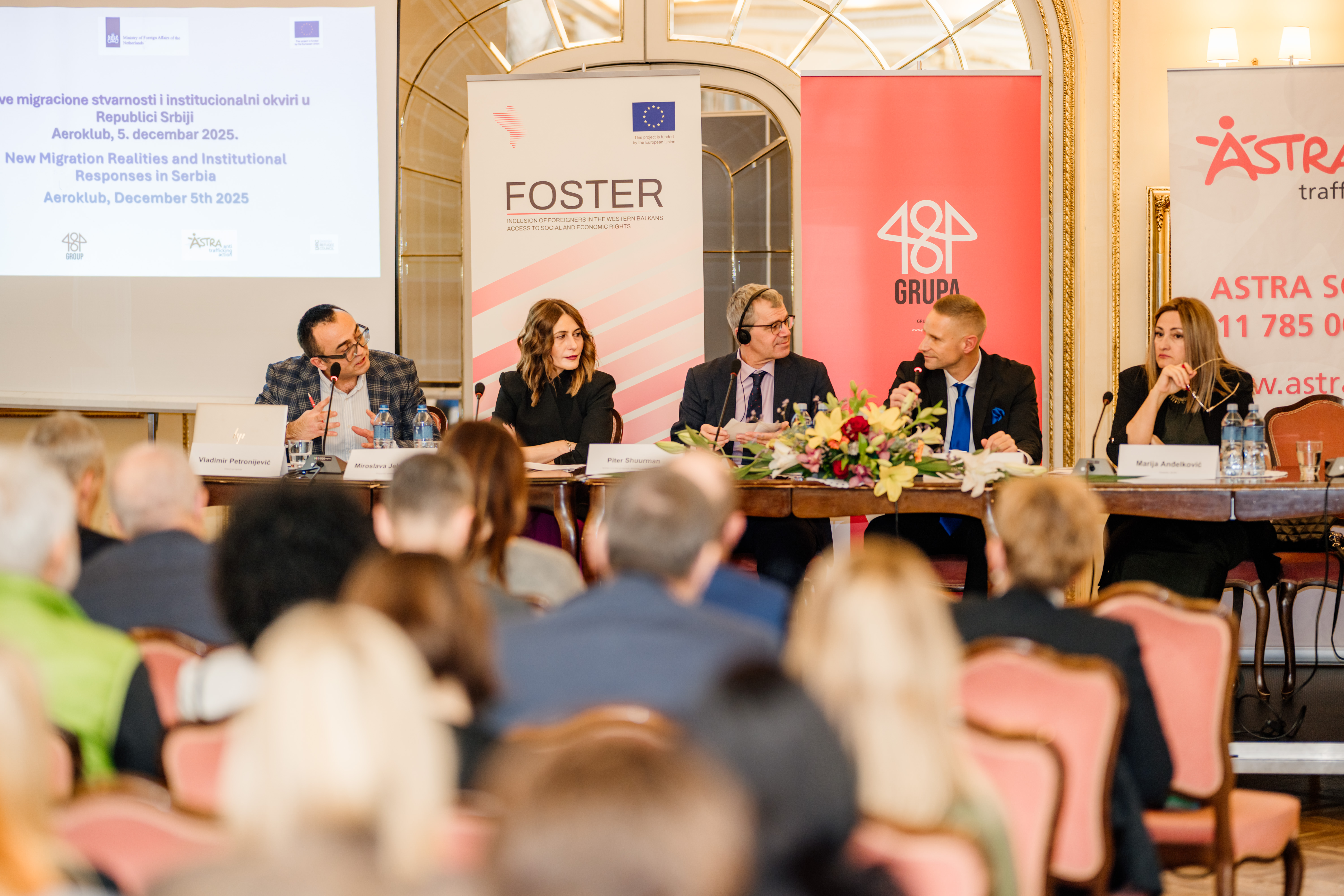
A thematic round table titled “New Migration Realities and Institutional Responses in Serbia” was held in Belgrade, organized by Group 484 and Astra.
ASTRA Director Marija Anđelković emphasized in her opening remarks that the challenges of migration flows are not only present in Serbia and the Balkans, and that it is important to learn from countries with developed systems, such as the Netherlands, from which ASTRA adopted knowledge in the fight against human trafficking 25 years ago.
She stressed that when discussing migration, it is essential to keep in mind that behind the statistics are human beings and real lives.
“Migration flows are changing rapidly, and smuggling networks are adapting very quickly to these changes. People who are far from their homes, often without documents and without knowledge of the language, are extremely vulnerable and susceptible to the influence of criminal groups,” said Anđelković.
She recalled that 71 victims of human trafficking were identified in Serbia last year, while ASTRA has recorded ten times more calls this year regarding labor exploitation and violations of labor rights, which clearly indicates that this problem requires much greater attention.
“Our job is to recognize the challenges, to be the voice of those whom the system does not see, and to seek effective solutions and ways to address these problems together with institutions,” said Anđelković.
Jelačić: Migration is not a temporary situation in Serbia, it is a reality
Miroslava Jelačić, legal analyst at Group 484, pointed to significant changes in migration flows over recent decades, reminding that the organization is celebrating 30 years of work. She emphasized that previous anniversaries marked key turning points – 15 years of work coincided with visa liberalization, while the twentieth anniversary was marked by the large refugee and migrant crisis.
“Today, as we celebrate three decades of existence, we are facing dynamic changes, an increase in labor migration, viewing migration as a development potential, but also new patterns of abuse, exploitation, and an increasingly pronounced need for effective institutional coordination,” said Jelačić.
She added that migration does not stop at borders.
Speaking about experiences from joint work with Astra, she noted that direct contact with migrants is important, with the aim of making their voice heard more strongly.
“Experience has helped us build capacity and better understand the connection between migration and various forms of exploitation. Migration is not a temporary situation in Serbia, it is a reality, and protection challenges are becoming increasingly greater and more complex,” she said.
Schuurman: Some lose their lives on the way to their destination
Special Envoy for Migration of the Ministry of Foreign Affairs of the Kingdom of the Netherlands, Peter Schuurman, said that migration represents one of the key topics of today.
“A large number of people are still trying to reach their destinations, and unfortunately, some lose their lives on that journey. In order to develop policies that can respond to such challenges, it is important that all actors are involved,” he said.
He emphasized that the improvement of migration policies is important so that the process is transparent, without the influence of corruption and organized crime.
Goldschmit: Local and foreign agencies make high profits on visa issuance
Migration Officer of the European Union Delegation in Serbia, Richard Goldschmit, emphasized that migration is one of the key global challenges, especially in the context of conflicts in the Middle East and climate change. He recalled that this is precisely why the new Pact on Migration and Asylum was adopted, which introduces additional guarantees regarding the conditions for receiving migrants, especially minors.
“The Western Balkans remains a strategic priority for the European Commission. We will continue to support Serbia in the EU accession process and in improving migration management,” said Goldschmit.
He emphasized that the action plan for the Western Balkans aims to strengthen joint support and a comprehensive approach to managing migration flows. According to him, Serbia has made progress in this area, while the implementation of the action plan has contributed to reducing migration pressure on the Balkan route.
“The fight against human smuggling remains one of the key pillars,” he emphasized.
He warned that cases have been recorded in which local and foreign employment agencies make high profits, especially in visa issuance procedures for foreign workers, and that criminal networks exploit workers and participate in smuggling and human trafficking operations.
Multiple panels held
At the first panel, titled “Adapting to New Forms of Smuggling and Human Trafficking – Institutional Practices and Systemic Adaptation,” participants discussed how institutions are adapting to new forms of smuggling and human trafficking resulting from changed migration patterns.
Panel participants included Danijela Trajković, Senior Public Prosecutor in Vranje, Nenad Simić, National Coordinator for Combating Human Trafficking (MUP), Prof. Milan Žarković, and Marija Vukašinović from Astra.
The panel discussed how abuse of legal migration channels occurs, how recruitment patterns are changing, and what the key challenges are in monitoring and early risk identification.
Panelists discussed how the prosecutor’s office, specialized coordination bodies, police structures, and victim protection services are adapting their operational practices, strengthening mutual cooperation and accountability, and how they are improving multisectoral detection and response mechanisms.
At the second panel, titled “Vulnerabilities in the New Migration Reality – Access to Rights and Institutional Protection,” participants examined how contemporary migration dynamics shape different types of vulnerabilities among migrants, with special focus on labor migrants and persons without regulated residence status.
Panel participants included Sanja Gavranović from the Ministry of Labor, Employment, Veteran and Social Affairs, Dr. Mario Reljanović from the Institute of Comparative Law, Milica Milić, Judge of the Misdemeanor Court, and Dajana Ristić from the Commissariat for Refugees and Migration.
Through presentations of experiences from neighboring countries, panelists highlighted common challenges, as well as practices that can serve as examples for improving institutional responses in Serbia.
FOTO: Ivan Aleksic