


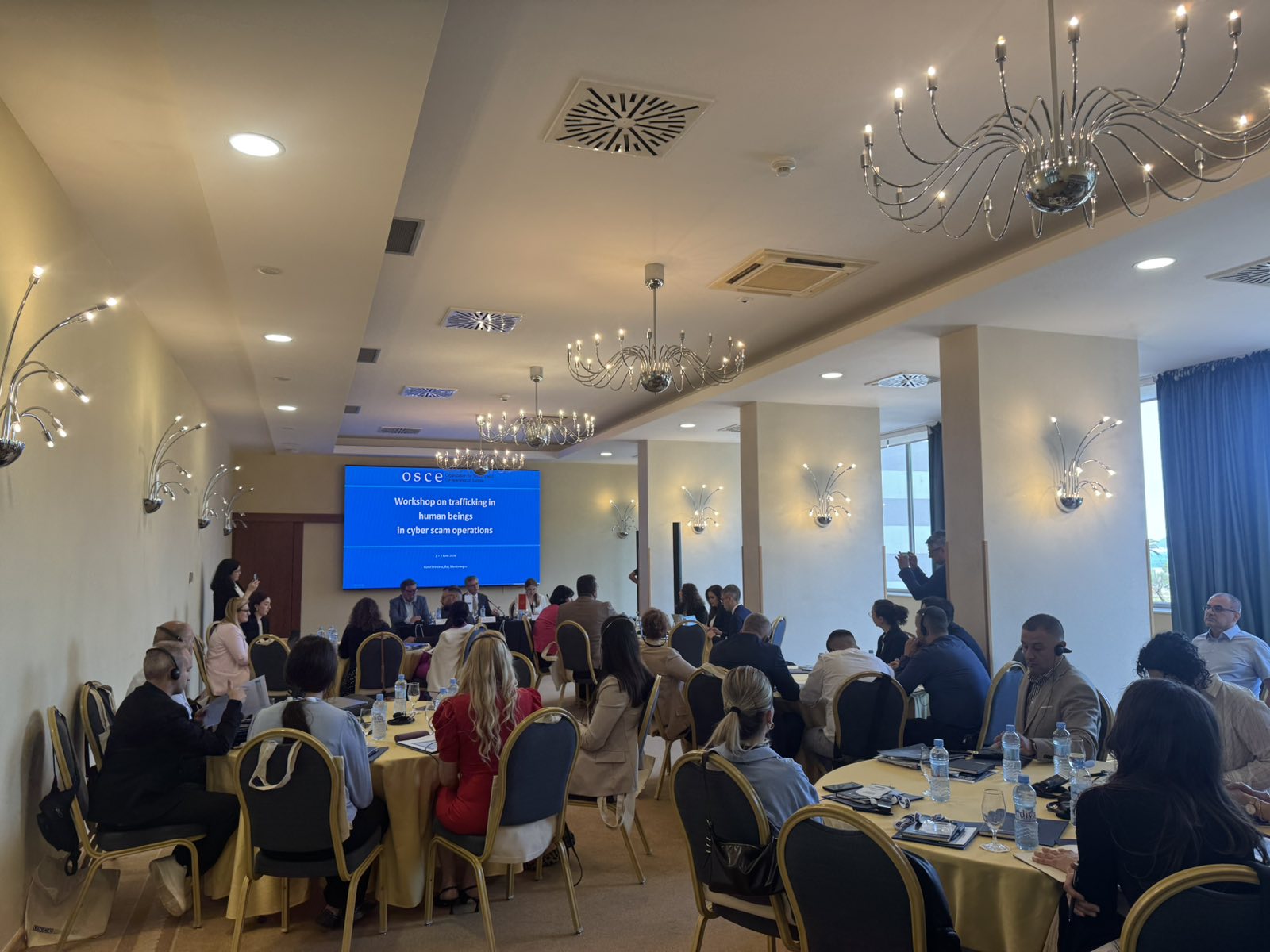
A regional workshop on trafficking in human beings in cyber scam operations was held in Bar, Montenegro, organized by the OSCE Office of the Special Representative and Co-ordinator for Combating Trafficking in Human Beings (OSR/CTHB), in cooperation with the OSCE field missions in Montenegro, Albania, Bosnia and Herzegovina, and North Macedonia. The event brought together representatives of law enforcement agencies, prosecutors’ offices, labour inspectorates, recruitment agencies, and civil society organizations from across the Western Balkans.
The workshop focused on the growing phenomenon of trafficking in human beings for the purpose of forced criminality in online scam operations, a form of exploitation that has expanded from Southeast Asia to other regions, including the OSCE area. Participants examined recruitment methods, the misuse of digital technologies, forced labour in so-called scam centres, and challenges related to victim identification and protection.
As part of the session on Responsible Business Conduct and Risk Mapping, Marija Andjelkovic, CEO of ASTRA – Anti-Trafficking Action, delivered a presentation on the risks posed by seemingly legitimate business structures, such as call centres, IT companies, marketing agencies, and cryptocurrency consulting firms, which can be used as fronts for human trafficking and exploitation. Particular attention was given to the role of recruitment agencies and labour intermediaries, risks associated with outsourcing and subcontracting chains, and indicators of forced criminality that may be present within business operations.
During the discussion, ASTRA shared its experience in assisting victims of labour exploitation and presented cases illustrating how fraudulent job advertisements, deceptive overseas employment offers, and digital tools are increasingly used to recruit individuals into cyber scam operations. The presentation highlighted the need for stronger cooperation between public institutions, the private sector, and civil society organizations, as well as enhanced corporate accountability and risk assessment mechanisms.
Participants also discussed regional challenges in detecting and addressing these crimes, exchanged good practices, and worked on developing joint recommendations aimed at strengthening prevention, victim identification, and cross-border cooperation in combating trafficking in human beings in cyber scam operations.
According to OSCE findings, citizens of countries across the region are increasingly becoming victims of trafficking for forced participation in online fraud schemes, while several Western Balkan countries have already been identified as locations where organized criminal networks operate scam centres using business models similar to those documented in Southeast Asia. The workshop in Bar represented an important step towards improving understanding of this emerging phenomenon and developing a coordinated regional response.